

Digital Seminar
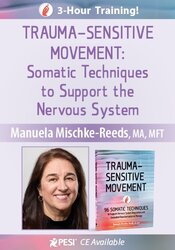
Trauma-Sensitive Movement: Somatic Techniques to Support the Nervous System
- Average Rating:
- Not yet rated
- Faculty:
- Manuela Mischke-Reeds, MA, LMFT, CHT
- Duration:
- 2 Hours 54 Minutes
- Format:
- Audio and Video
- Copyright:
-
Mar 24, 2025
- Product Code:
- POS150137
- Media Type:
- Digital Seminar

Description
Help clients access what is held in their bodies so they can move with and beyond their trauma stories.
Movement is a fundamental, innate expression of the body that can serve as a powerful tool for processing trauma, releasing deeply held emotions, and re-establishing a client's sense of embodiment.
Introducing movement into trauma work can feel challenging – but it doesn’t have to!.
In this 3-hour recording, bestselling author and experienced somatic psychotherapist Manuela Mischke-Reeds, MA, MFT, will show you effective and safe ways to incorporate movement techniques with trauma clients to facilitate healing and integration.
Using a refreshing combination of didactic and experiential teaching, Manuela will provide you with the clinical insight and tools you need to:
-
Recognize when it is appropriate to use movement as an active intervention for trauma processing.
-
Observe and track the moving body to gain diagnostic insight into trauma patterns
-
Use movement techniques to support clients’ emotional regulation and resilience
-
And more!
Credit
Handouts
| File type | File name | Number of pages | |
|---|---|---|---|
| Manual - Trauma-Sensitive Movement (15.5 MB) | 24 Pages | Available after Purchase | |
| Manual - Trauma-Sensitive Movement - French (15.5 MB) | 24 Pages | Available after Purchase | |
| Manual - Trauma-Sensitive Movement - Italian (15.5 MB) | 24 Pages | Available after Purchase |
Faculty

Manuela Mischke-Reeds, MA, LMFT, CHT Related seminars and products
Manuela Mischke-Reeds, MA, LMFT, CHT, is a somatic psychotherapist, international teacher of Somatic Psychology, author and consultant. She is the founder of Embodywise and co-director of Hakomi California. She trains and consults professionals in varied fields, including health professionals and business leaders. Her trainings in the United States, Australia, Germany, China and Israel bring together 25 years in-depth clinical practice and teaching. She integrates Hakomi Mindful somatic Psychotherapy, Somatic trauma therapies, embodied mindfulness practices and movement therapies.
Manuela is the founder of ISITTA trauma training. Her trauma teachings are grounded in an inside-out approach that utilizes the depth of the body’s innate healing capacity.
Manuela is the author of several books, including 125 Somatic Psychotherapy tools for Trauma and Stress (PESI 2018), 8 Keys to Practicing Mindfulness: Practical Strategies for Emotional Health and Well Being (W.W. Norton 2015). Visit Manuela’s website to find out more about her work: www.embodywise.com.
Speaker Disclosures:
Financial: Manuela Mischke-Reeds is the founder of Embodywise and has an employment relationship with Embodylab. She receives compensation as a consultant and royalties as a published author. She receives a speaking honorarium, recording, and book royalties from PESI, Inc. She has no relevant financial relationships with ineligible organizations.
Non-financial: Manuel Mischke-Reeds has no relevant non-financial relationships.
Additional Info
Questions?Visit our FAQ page at www.pesi.com/faq or contact us at www.pesi.com/info
Objectives
- Analyze the impact of trauma-informed movement techniques on the autonomic nervous system.
- Determine client readiness to safely and effectively engage in trauma-sensitive movement.
- Choose techniques to support trauma integration, regulate emotions, and support resilience.
- Utilize observation and tracking of clients’ movement to gain diagnostic insight into the impact of trauma on the body.
Outline
Beyond Somatic Awareness: Bringing Movement into Trauma Treatment
- Why the integration of movement with trauma therapy?
- How the body responds to traumatic stress
- Clinical considerations: safety, sensitivity, and support
- What to avoid: Risks and limitations of the research
- Group Experiential: Guided movement exercise to attune to the body in a trauma-informed way
Movement, Emotions, and Sensations: Building Resilience and Resources
- Using the body as a diagnostic tool
- Five key movement impulses (fight, flight, freeze, submit, and flow)
- How to read and track the body’s responses to trauma
- Techniques that support trauma integration, help regulate emotions, and support resilience
- Group Experiential: Guided movement exercise to strengthen emotional resources and resilience in the body
Target Audience
- Social Workers
- Psychologists
- Psychiatrists
- Counselors
- Case Managers
- Marriage and Family Therapists
- Therapists
Reviews
Satisfaction Guarantee
Your satisfaction is our goal and our guarantee. Concerns should be addressed to: PO Box 1000, Eau Claire, WI 54702-1000 or call 1-800-844-8260.
ADA Needs
We would be happy to accommodate your ADA needs; please call our Customer Service Department for more information at 1-800-844-8260.
Please wait ...