

Digital Version Available
Get immediate lifetime access to this content by purchasing the digital seminar/online course instead that you can access using a variety of devices, and one CE certificate is included with purchase! Click the “Digital Seminar” or "Online Course" link below to learn more!
DVD Purchasers please note: In order to view the content, you will be required to have a DVD player or a DVD drive on your computer. Your CE is a separate fee.
DVD
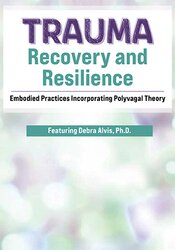
Trauma Recovery and Resilience: Embodied Practices Incorporating Polyvagal Theory
- Average Rating:
- Not yet rated
- Faculty:
- Debra Premashakti Alvis, PhD
- Duration:
- 6 Hours 08 Minutes
- Copyright:
-
Aug 18, 2021
- Publisher:
- PESI Inc.
- Product Code:
- RNV057960
- Media Type:
- DVD - Also available: Digital Seminar

Description
After experiencing trauma, our clients often dissociate from their bodies aiming to escape intense sensations and emotional pain. They then increasingly react to inner and outer cues linked to behavioral patterns that are below conscious awareness.
Even after treatment, clients who have experienced severe or sustained trauma, are often overwhelmed by residual symptoms and are trapped in reactivity to triggers. Safe-embodiment skills, carefully introduced, sequenced, and titrated, can move clients beyond the life-diminishing cycles of avoidance and re-traumatization.
In this live online training, you will learn an array of skills designed to create the safety needed to work with the body and with fearful parts of the self. You will learn how to help clients identify, befriend, and shift autonomic states and parts of the self that otherwise perpetuate avoidance and reactivity.
In both virtual and in-person therapy sessions, you will be able to offer embodied trauma-resiliency tools designed to strengthen vagal tone and the motivation to incorporate these vagal toning strategies into their daily lives. Integrate and sequence dialogue with parts of the self with gentle movement and breath, increasing your client’s self-efficacy, steadiness, and ability to choose rather than react.
Watch Debra, an experienced international presenter, in this day of experiential learning as she shares embodied Polyvagal Theory applications. Conclude the day with new tools for trauma recovery and vibrant resiliency.
Purchase today!
Credit
Handouts
| File type | File name | Number of pages | |
|---|---|---|---|
| Manual - Trauma Recovery and Resilience (37.1 MB) | 89 Pages | Available after Purchase | |
| CE Test – 057960 – Paper Option (258.5 KB) | Available after Purchase |
Faculty

Debra Premashakti Alvis, PhD Related seminars and products
Debra Premashakti Alvis, PhD, is a licensed psychologist and private practitioner with over 30 years of clinical experience in supporting clients’ recovery from trauma, mood and relational concerns. Debra began working with parts of the self over three decades ago training extensively in Jungian oriented psychotherapy and contemplative approaches. She applied movement, mindfulness, and the expressive arts to explore parts of the self. She deepened her understanding of inner parts through multiple Internal Family Systems therapy educational trainings, combining her embodied contemplative approach with the IFS model. She finds that this integrative approach strengthens the self through facilitating the resolution of inner conflicts.
A seasoned international presenter and consultant, Dr. Alvis is a therapeutic yoga educator and mindfulness meditation teacher. She retired as faculty member from the University of Georgia where she developed and led the mind/body program. The program included a clinician training program integrating mindfulness, yoga and psychotherapy. A personal contemplative practice, research experience, and a deep understanding of Polyvagal Theory further enrich her presentations. She draws upon this unique background to provide effective, easily applicable skills designed for immediate integration into clinicians’ practices.
In addition to teaching, Dr. Alvis maintains a private practice and has more than 25 years of clinical experience in treating clients with a variety of conditions by mindfulness principles, body-oriented principles and traditional psychotherapeutic approaches. She also has an over 30-year personal contemplative practice.
Speaker Disclosures:
Financial: Debra Alvis maintains a private practice and receives a speaking honorarium from PSIvet, Ridgeview Institute, Twin Lakes Recovery Center, eCare, Essential Therapy Training, Alma, CEU Creations and Mountain Area Health Education Center. She is a paid consultant for Evergreen Certifications. Debra Alvis receives a speaking honorarium and recording royalties from PESI, Inc. She has no relevant financial relationships with ineligible organizations.
Non-financial: Debra Alvis is a member of the American Association of College Student Personnel, the Association for Contemplative Mind in Higher Education, the Association of Specialists in Group Work, the Athens Area Psychological Association, and the Georgia Psychological Association.
Additional Info
Access for Self-Study (Non-Interactive)Access never expires for this product.
Objectives
- Analyze how the primary tenets of Polyvagal theory can be applied to trauma treatment through embodied contemplative practice.
- Demonstrate how compassion-based interventions shift vagal states and shame-based trauma reactions.
- Demonstrate inner dialogue with disowned aspects of the self for building a secure attachment to the self.
- Demonstrate two breathing practices for calming fight/flight, energizing the body, and focusing the mind.
- Integrate simple movements to relieve anxiety and shift from shut down.
- Develop cultural sensitivity through individualizing treatment.
Outline
Apply Polyvagal Theory in Trauma Treatment- Vagal States & Autonomic Hierarchy
- Neuroception – how the traumatized nervous system interfaces with the world
- Re-establish effective co-regulation – a biological imperative
- Utilize prosody or voice
- Provide trauma-informed psychoeducation on intermingled vagal states
- Build Recovery & Resiliency Through Smart Vagal Activity
- Subcortical resilience
- Eye movements to build resiliency
- Resourcing – Map vagal states and pivotal practices
- Energizing Breaths to Stimulate Safety in Social Connection
- Skull shining breath
- Ocean sounding breath
- Calming breaths to stem anxiety
- Three-part breath
- Shining moon breath
- Movements to Awaken the Shut-Down Nervous System
- Gentle back-bending movements
- Standing stretches to focus mind/body
- Goddess posture – Breath plus movement
- Movements to Calm Fight/Flight
- Easy forward bending
- Simple sigh & stretch
- A dance with the hands - Mudras
- Face-to-Heart Connection Through Sound & Movement
- Call & response chant
- Walking meditation to awaken compassion
- Loving kindness imagery
- Identify vagal state triggers and resets
- The five senses – A return to the here and now
- Deep relaxation to support safe connection
- Adapt and individualize trauma treatment with cultural sensitivity
- Apply Polyvagal Theory to racial healing
- Extend resiliency building to implicit memory, body memory, and procedural conditioning
- Explore ahimsa or non-violence with self and clients
- Self-compassion to negotiate fight/flight from inner critic
- Build safety and connection between sessions
- Right action & ethics for strengthening ANS resiliency
- Mirror through matching the client’s vagal states
- Shift self and client back into connection
Target Audience
- Counselors
- Social Workers
- Psychologists
- Case Managers
- Addiction Counselors
- Physicians
- Marriage and Family Therapists
- Nurses
- Other Mental Health Professionals
Reviews
Satisfaction Guarantee
Your satisfaction is our goal and our guarantee. Concerns should be addressed to: PO Box 1000, Eau Claire, WI 54702-1000 or call 1-800-844-8260.
ADA Needs
We would be happy to accommodate your ADA needs; please call our Customer Service Department for more information at 1-800-844-8260.
Please wait ...