

Digital Version Available
Get immediate lifetime access to this content by purchasing the digital seminar/online course instead that you can access using a variety of devices, and one CE certificate is included with purchase! Click the “Digital Seminar” or "Online Course" link below to learn more!
DVD Purchasers please note: In order to view the content, you will be required to have a DVD player or a DVD drive on your computer. Your CE is a separate fee.
This program is no longer active, however there are other versions of this program in which you may be interested.
Smart but Scattered: Effective Executive Functioning Strategies to Empower Children to Thrive Emotionally, Socially, and Academically, 9/30/2025 12:00:00 AM EDT, Digital Seminar More info »
Smart but Scattered: Effective Executive Functioning Strategies to Empower Children to Thrive Emotionally, Socially, and Academically, 9/30/2025 12:00:00 AM EDT, Digital Seminar More info »
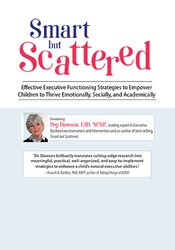
DVD
Purchase Additional Physical CE »
Smart But Scattered: Executive Dysfunction at Home and at School
- Average Rating:
- 21
- Faculty:
- Margaret Dawson, EdD, NCSP
- Duration:
- 6 Hours 22 Minutes
- Copyright:
-
Dec 14, 2021
- Publisher:
- PESI Inc.
- Product Code:
- RNV041380
- Media Type:
- DVD - Also available: Digital Seminar
Description
Children who have deficient executive skills often have trouble getting started on tasks, get distracted easily, lose papers or assignments and forget to hand in homework. They make careless mistakes, put off work until the last minute and have no sense of time urgency. Workspaces are disorganized and teachers often refer to their backpacks or lockers as “black holes.” Often considered chronic underachievers, these children are at risk for academic failure as well as emotional and behavioral difficulties.
Dr. Dawson, co-author of the best-selling books Executive Skills in Children and Adolescents, 3rd Ed. (2018), Smart but Scattered (Guilford, 2009) and Smart but Scattered Teens (2013, Guilford) uses case examples along with interactive discussion to demonstrate how the executive skills manifest in daily home and school activities. Learn how to assess these skills and take home evidence-based strategies to help children and adolescents overcome executive skills weaknesses.
Leave this seminar with a set of tools that includes strategies for task/environmental modifications, skill development through cognitive/behavioral techniques and creation of incentive systems. You will be able to give teachers and parents a means for developing and improving the following:
- Organization
- Time management
- Impulse control
- Goal-directed persistence
- Executive skills critical for independent functioning
Credit
Handouts
| File type | File name | Number of pages | |
|---|---|---|---|
| Manual - Smart But Scattered: Executive Dysfunction at Home and at School (3.3 MB) | 72 Pages | Available after Purchase | |
| CE Test - 041380 - Paper Option (317.4 KB) | 11 Pages | Available after Purchase | |
| Illinois Educators Self-Study Instructions (15.4 KB) | Available after Purchase | ||
| Illinois Educators Evaluation Form (1.2 MB) | Available after Purchase | ||
| Instructions for ASHA credit - Self-Study Only (64.4 KB) | Available after Purchase | ||
| Updated Handouts (11.9 MB) | 146 Pages | Available after Purchase | |
| Updated Handouts - German (11.9 MB) | 146 Pages | Available after Purchase | |
| Updated Handouts - Spanish (11.9 MB) | 146 Pages | Available after Purchase |
Faculty

Margaret Dawson, EdD, NCSP Related seminars and products
Peg Dawson, EdD, NCSP, is a school psychologist and for over 20 years has worked at the Center for Learning and Attention Disorders in Portsmouth, New Hampshire, where she specializes in the assessment of children and adults with learning and attention disorders. She is co-author of the bestselling books on executive dysfunction, Executive Skills in Children and Adolescents: 2nd Edition (Guilford, 2010), Smart but Scattered (Guilford, 2009) and Smart but Scattered Teens (Guilford, 2013).
Peg is a past editor of Communiqué, the newsletter of the National Association of School Psychologists, and has published numerous articles and book chapters on a variety of topics, including retention, ability grouping, reading disorders, attention disorders, the sleep problems of adolescents, the use of interviews in the assessment process, and homework.
Peg has many years of organizational experience at the state, national and international levels and served in many capacities, including president of the New Hampshire Association of School Psychologists, the National Association of School Psychologists (NASP) and the International School Psychology Association.She has also participated in many of NASP’s leadership initiatives, including the Futures Conference and the development of both the second and third Blueprint for the Training and Practice of School Psychology. She is the 2006 recipient of NASP’s Lifetime Achievement Award. Peg received her doctorate in school/child clinical psychology from the University of Virginia.
Speaker Disclosures:
Financial: Margaret (Peg) Dawson is an author for Guilford Press and receives royalties. She is an author for Amacon publishers and receives royalties. She receives a speaking honorarium from PESI, Inc.
Non-financial: Margaret (Peg) Dawson has no relevant non-financial relationships.
Additional Info
Access for Self-Study (Non-Interactive)Access never expires for this product.
Questions?
Visit our FAQ page at www.pesi.com/faq or contact us at www.pesi.com/info
Objectives
- Assess the relationship between the executive skills and brain development/function in relation to assessment and treatment planning.
- Propose strategies to accommodate and strengthen weak planning and organizational skill, to improve client level of functioning.
- Appraise assessment tools used to identify deficits in executive functioning to better inform your choice of treatment interventions.
- Determine how executive skills impact performance and activities of daily living at home and school for the purpose of client psychoeducation.
- Utilize environmental modification strategies to support deficits in executive skills thus improving treatment outcomes.
- Implement strategies that transition children from being externally prompted to internally regulated.
Outline
Executive Skills- Underlying theory
- Executive skills in the context of brain function and child development
- Limitations of the research and potential risks
- Parent/teacher/student interviews
- Behavior rating scales
- Observations
- Informal assessment
- Formal assessment
- Environmental modifications to reduce the impact of weak executive skills
- Teaching strategies to help children develop/improve executive functioning
- Using incentives to help practice or use skills that are difficult
- Match the child’s developmental level
- Use the child’s innate drive for mastery and control
- Begin with environmental modifications
- Effortful tasks and ways to make them less difficult
- Use incentives to augment instruction
- Provide the minimum support necessary
- Apply supports and interventions until the child achieves mastery or success
- Gradually fade supports, supervision, and incentives
- Description of 2-stage process
- Coaching with younger children
- Clinical case examples
- Research studies supporting the efficacy of coaching
Limitations of the Research and Potential Risks
- Limited empirical evidence for the approach
- Approach integrates evidence-based practices such as ABA and RTI
- No “one size fits all” for any treatment modality
Target Audience
- Counselors
- Social Workers
- Psychologists
- Psychotherapists
- Therapists
- Marriage and Family Therapists
- Speech-Language Pathologists
- Teachers
- School Guidance Counselors
- Case Managers
- Nurses
- School Administrators
- Educational Paraprofessionals
- Occupational Therapists
- Occupational Therapy Assistants
- Other Helping Professionals Who Work with Children
Reviews
| 5 |
|
| 4 |
|
| 3 |
|
| 2 |
|
| 1 |
|
Overall: 4.8
Total Reviews: 21
Satisfaction Guarantee
Your satisfaction is our goal and our guarantee. Concerns should be addressed to: PO Box 1000, Eau Claire, WI 54702-1000 or call 1-800-844-8260.
ADA Needs
We would be happy to accommodate your ADA needs; please call our Customer Service Department for more information at 1-800-844-8260.
Please wait ...