

This program is not active.
Digital Seminar
Purchase Additional Participant CE »
Psychopharmacology: What You Need to Know Today About Psychiatric Medications
- Average Rating:
- 32
- Faculty:
- Tom Smith, P.D., FASCP, LMHC, NCP, BCCP
- Duration:
- Full Day
- Format:
- Audio and Video
- Copyright:
-
Aug 21, 2014
- Product Code:
- POS050515
- Media Type:
- Digital Seminar
Description
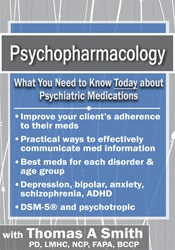
- Improve your clients’ adherence to their meds
- Practical ways to effectively communicate med information
- Best meds for each disorder & age group
- Depression, bipolar, anxiety, schizophrenia, ADHD
- DSM-5® and psychotropic med use
Most Up-To-Date Psychotropic Medication Info - Guaranteed!
Demands on mental health professionals to expand their knowledge of psychotropic meds are like never before . . . not only do you need to be on top of the latest developments and what is on the horizon, but you also have to take that information, and use it most effectively for your client.
- Proven methods to improve clients’ understanding of their mental illness, and how medication aids recovery
- Identifying treatment concerns with inappropriate, inadequate doses of medication
- Tools to help clients manage unpleasant side effects
- Strategies to improve client adherence to medications
- Depression, bipolar, anxiety, schizophrenia, ADHD -- the latest trends in medication management
OUTLINE
Biological Psychiatry
- Neurotransmitters: The brain’s building blocks
Depression
- Antidepressants: How they work
- Cyclics
- SSRIs
- SNRIs
- Atypicals/combining antidepressants
- Side effects and risk factors
- Herbals and depression
- Treatment-resistant depression
- Improving compliance with antidepressants
- What you and your clients should know
Bipolar Disorder
- Medicating Bipolar disorder
- Lithium as the “gold standard”
- Side effects of Lithium
- Anticonvulsant and antispsychotic use in Bipolar disorder
- Anticonvulsant side effects
- Risks of medication non-compliance
The Many Manifestations of Anxiety
- Panic disorder
- Medicating anxiety
- Benzodiazepines
- Non benzodiazepines
- Medications used to treat insomnia
- Ambien, Lunesta, Sonata, Rozerem, Intermezzo
- Using anxiolytics safely
- Side effects of the anxiolytics
Schizophrenia
- Symptom domains of schizophrenia
- How antipsychotics work
- Conventional antipsychotics
- Second generation agents
- Antipsychotic side effects
- Relapse and non compliance
Special Populations: Children, Adolescent, Elderly
- Using medications for children to treat diagnoses usually found in children
- Medicating pediatric depression
- Antidepressants and suicide in children:
- The real truth
- Pediatric Bipolar disorder
- Medicating anxiety in children
- ADHD and its expanding etiology
- The evolution of psychostimulants
- Antidepressant, non-stimulates use in ADHD
- Alzheimer’s medications
DSM-5® and Psychotropic Med Use
What’s Next: Breakthrough Antipsychotics and Antidepressants
Collaborating with Clients, Families, and Prescribers: Techniques that Work!
OBJECTIVES
- Discuss the clinical uses of the five major psychotropic medication classes—the antidepressants, mood stabilizers, anti-anxiety agents, antipsychotics and psychostimulants— how they work, and their common side effects.
- Describe the benefits, risks, safety factors and controversies associated with psychotropic medication use in children and adolescents.
- Address the wide array of mental health disorders for which medications are frequently prescribed.
- Examine what’s coming next as well as emerging and innovative trends in psychopharmacology.
- Implement effective methods for collaborating with clients, families and prescribers.
- Recognize the ethical and legal issues in discussing medications with clients.
To order the book, My Mental Health Medication Workbook, please visit our product store.
To order the book, Psychopharmacology: Straight Talk on Mental Health Medications – 2nd Edition, please visit our product store.
Credit
Handouts
| File type | File name | Number of pages | |
|---|---|---|---|
| Revised Slide Handout (1.6 MB) | Available after Purchase | ||
| Buy It/Rent It Manual (2.5 MB) | 64 Pages | Available after Purchase |
Faculty
Tom Smith, P.D., FASCP, LMHC, NCP, BCCP Related seminars and products
Tom Smith, P.D., FASCP, LMHC, NCP, BCCP, is a Doctor of Pharmacy, a Licensed Mental Health Counselor, a Nationally Certified Psychologist, and a Board Certified Clinical Counselor. He holds academic appointments at Butler School of Pharmacy and Health Sciences, the Saint Louis University School of Graduate Nursing, and the University of Phoenix. Tom is a Fellow of the American Society of Consulting Pharmacists.
Tom has spoken on Bipolar Disorder, the DSM-5®, and psychopharmacology throughout the United States, He is the author of Psychopharmacology Made Simple: A Primer, and he is internationally published on the topic of Aromatherapy.
Tom maintains an active private practice in Martinsville, Indiana, where he works with clients of all ages.
Speaker Disclosures:
Financial: Tom Smith maintains a private practice. He will address ‘off-label’ uses of commercial products. Mr. Smith is a speaker who receives an honorarium for PESI, Inc.
Non-Financial: Tom Smith is nationally published on the Americans with Disabilities Act and receives no compensation.
Additional Info
Access for Self-Study (Non-Interactive) Access never expires for this product.Target Audience
Psychologists, Social Workers, Counselors, Case Managers, Addiction Counselors, Nurses, Clinical Nurse Specialists, Marriage & Family Therapists, Therapists, Others in caring professionsReviews
| 5 |
|
| 4 |
|
| 3 |
|
| 2 |
|
| 1 |
|
Overall: 4.9
Total Reviews: 32
Satisfaction Guarantee
Your satisfaction is our goal and our guarantee. Concerns should be addressed to: PO Box 1000, Eau Claire, WI 54702-1000 or call 1-800-844-8260.
ADA Needs
We would be happy to accommodate your ADA needs; please call our Customer Service Department for more information at 1-800-844-8260.
Please wait ...