

This program is no longer active, however there are other versions of this program in which you may be interested.
Psychopharmacology: Essential Information for Mental Health Professionals, 6/27/2025 12:00:00 AM EDT, Digital Seminar More info »
Psychopharmacology: Essential Information for Mental Health Professionals, 6/27/2025 12:00:00 AM EDT, Digital Seminar More info »
Digital Seminar
Purchase Additional Participant CE »
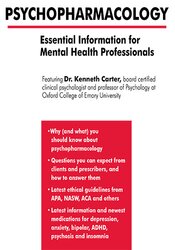
Psychopharmacology: Essential Information for Mental Health Professionals
- Average Rating:
- 6
- Faculty:
- Kenneth Carter, PhD, ABPP
- Duration:
- 6 Hours 18 Minutes
- Format:
- Audio and Video
- Copyright:
-
Jun 03, 2021
- Product Code:
- POS054845
- Media Type:
- Digital Seminar - Also available: Digital Seminar
Description
Dr. Kenneth Carter, a board certified clinical psychologist with a Master’s degree in clinical psychopharmacology, shares his clinical experience and training to provide detailed information about the range of common medications prescribed for mental health conditions. You will get the latest information on antidepressants, anxiolytics, and common medications for insomnia and Attention Deficit/Hyperactivity Disorder among others. Through lecture, the examination of multi-disciplinary ethics codes and real case examples, you will take a close look at the ethical decisions that accompany medication use and the non-prescriber's role and limits with regards to medication discussions with your patients.
Dr. Carter answers questions from providers in the field and walks through examples of practical clinical discussions that come up every day in practice, including how to discuss scope of practice with your patients in order to optimize their care when working with multiple providers. The goal is for you to leave better prepared to communicate with your clients as well as the prescribers, as Dr. Carter instructs you on how the medications work, their benefits, and the side effects and dangerous reactions associated with them.
Credit
Handouts
| File type | File name | Number of pages | |
|---|---|---|---|
| Manual - Psychopharmacology (3.4 MB) | 53 Pages | Available after Purchase | |
| Modules 1-2 Manual | Psychopharmacology - French (3.44 MB) | 53 Pages | Available after Purchase | |
| Modules 1-2 Manual | Psychopharmacology - Italian (3.44 MB) | 53 Pages | Available after Purchase | |
| Modules 1-2 Manual | Psychopharmacology - German (3.44 MB) | 53 Pages | Available after Purchase | |
| Modules 1-2 Manual | Psychopharmacology - Spanish (3.44 MB) | 53 Pages | Available after Purchase |
Faculty

Kenneth Carter, PhD, ABPP Related seminars and products
Kenneth Carter, PhD, ABPP, is a board-certified clinical psychologist and professor of psychology at Oxford College of Emory University in Atlanta, Georgia. Dr. Carter received his MA and PhD in clinical psychology from the University of Michigan in Ann Arbor and a postdoctoral master's degree in clinical psychopharmacology from Fairleigh Dickerson University. Dr. Carter has taught clinical psychopharmacology classes at Emory University since 2005 and has presented highly rated psychopharmacology workshops to clinicians throughout the United States since 2010. Dr. Carter has served as a senior assistant research scientist in the Epidemic Intelligence Service of the Centers for Disease Control and Prevention. He has been a psychotherapist and researcher for more than 20 years, during which time he has garnered awards from the National Institutes of Health, the National Heart, Lung and Blood Institute, and the University of Michigan. Dr. Carter has presented at numerous conferences and written several books and articles on introductory psychology, neuropsychology and psychopharmacology.
Speaker Disclosures:
Financial: Dr. Kenneth Carter has employment relationships with Positive Impact Health Centers and Oxford College of Emory University. He is a published author and receives royalties. Dr. Carter receives a speaking honorarium and recording royalties from PESI, Inc. He has no relevant financial relationships with ineligible organizations.
Non-financial: Dr. Kenneth Carter is a member of the American Psychological Association, the Association for Psychological Science, the Neuroscience Education Institute, the American Association for the Advancement of Pharmocotherapy, and the American Board of Professional Psychology.
Alternate Options
|
Psychopharmacology: Essential Information for Mental Health Professionals
Copyright: 06/27/2025 - Product Code POS054845 |
Additional Info
Access for Self-Study (Non-Interactive)Access never expires for this product. For a more detailed outline that includes times or durations of time, if needed, please contact cepesi@pesi.com.
Objectives
- Discuss the proper role of mental health professionals who treat clients receiving both psychotherapeutic medications and psychotherapy.
- Describe specific ethical issues and resolutions related to communicating with clients and prescribing professionals about psychotropic medications.
- Explain the neurotransmitter systems and neuroanatomy underlying the biological basis for mental disorders and pharmacotherapy.
- Identify the major classes of drugs used to treat mental disorders and which mental disorders are appropriately treated with each class of drugs.
- Describe adverse effects and drug reactions of the commonly prescribed psychotropic medications and when to alert the prescriber about them.
- Analyze the role that half-life plays in the efficacy of insomnia medications prescribed for clients and how it may affect behavioral interventions.
Outline
MEDS 101- Case study
- Reasons to be knowledgeable about psychiatric medications
- Lessons from other disciplines
- Pharmacy
- Nursing
- Ethics guidelines
- The common questions clients have about their medications
- Handling differences of opinion between non-prescribers and prescribers
- Organization of the nervous system
- Structure of the neuron
- Communication between neurons
- How medicines interact with the nervous system
- Neurobiology
- SSRIs and SNRIs
- Mechanism of action
- Benefits and adverse reactions
- Medications in these categories
- Case Study
- DSM-5® anxiety categories
- Deconstructionist approach taken by prescribers
- Neurobiology
- SRRIs and Benzodiazepines
- Mechanism of action
- Benefits and adverse reactions
- Medications in these categories
- Case study
- Monotherapy
- Lithium, anticonvulsants, and 2nd generation antipsychotics
- Mechanism of action
- Benefits and adverse reactions
- Medications in these categories
- Case study
- Neurobiology
- Methylphenidate and amphetamine
- Mechanism of action
- Delivery systems
- Benefits and adverse reactions
- Medications in these categories
- Case study
- Psychosis symptoms
- Neurobiology
- 1st and 2nd generation Antipsychotics
- Mechanism of action
- Benefits and adverse reactions
- Medications in these categories
- Case study
- Causes and treatments for insomnia
- Medications for insomnia
- Half-life
- Benefits and adverse reactions
- Case study
Target Audience
- Counselors
- Social Workers
- Psychologists
- Psychotherapists
- Physicians
- Case Managers
- Marriage & Family Therapists
- Nurses
- Nurse Practitioners
- Clinical Nurse Specialists
- Physician Assistants
- Addiction Counselors
- Pharmacists
- Occupational Therapists
- Occupational Therapy Assistants
- Other Mental Health & Healthcare Professionals



Reviews
| 5 |
|
| 4 |
|
| 3 |
|
| 2 |
|
| 1 |
|
Overall: 4.8
Total Reviews: 6
Satisfaction Guarantee
Your satisfaction is our goal and our guarantee. Concerns should be addressed to: PO Box 1000, Eau Claire, WI 54702-1000 or call 1-800-844-8260.
ADA Needs
We would be happy to accommodate your ADA needs; please call our Customer Service Department for more information at 1-800-844-8260.
Please wait ...