

Digital Seminar
Psychological Flexibility for a Traumatizing World: How to Foster the Most Important Skill in All of Psychotherapy
- Average Rating:
- Not yet rated
- Faculty:
- Steven C. Hayes, Ph.D.
- Duration:
- 8 Hours 30 Minutes
- Format:
- Audio and Video
- Copyright:
-
Sep 04, 2025
- Product Code:
- POS150271
- Media Type:
- Digital Seminar

Description
In this groundbreaking two-part workshop recording, Dr. Steven C. Hayes will explore how the future of therapy lies in understanding and enhancing psychological flexibility as a set of skills people can learn. He will show you that you have the skills and knowledge to begin, without necessarily having to “learn a new form of therapy” and how this approach quickly provides a powerful alternative to traditional diagnosis such as the DSM.
The Day 1 workshop recording will focus on What Matters and How to Read It. Dr. Hayes will delve into what behavioral science suggests is the most important skill set in all of mental and behavioral health: Learning how to be more flexible. He will define what that is and how we know that it’s important scientifically, but will also show that both you and your clients already know this even if you do not know that you know it. Having defined the skills we need to develop, he will show you how to detect these processes in therapy and to bring attention to them. A subtext is that one size fits none, and each particular person, couple, or family is unique, but that there is a kind of alphabet of suffering and human prosperity that will make sense of it.
The Day 2 workshop recording will focus on Empowerment Processes: From Them, Toward Them, and With Them. Dr. Hayes will shift the focus to how therapists can utilize the therapeutic alliance and modern measurement and AI tools to model and support these flexibility skills, addressing modern challenges such as the ubiquity of trauma or the distress, anxiety, and sadness that global failures can engender. By personalizing intervention with a focus on empowerment processes this workshop not only begins to redefine mental and behavioral health care but also equips practitioners with the tools to use their existing therapeutic skills within a process-based framework for transformative change.
Credit
Handouts
| File type | File name | Number of pages | |
|---|---|---|---|
| Link | Manual |
Faculty
Steven C. Hayes, Ph.D. Related seminars and products
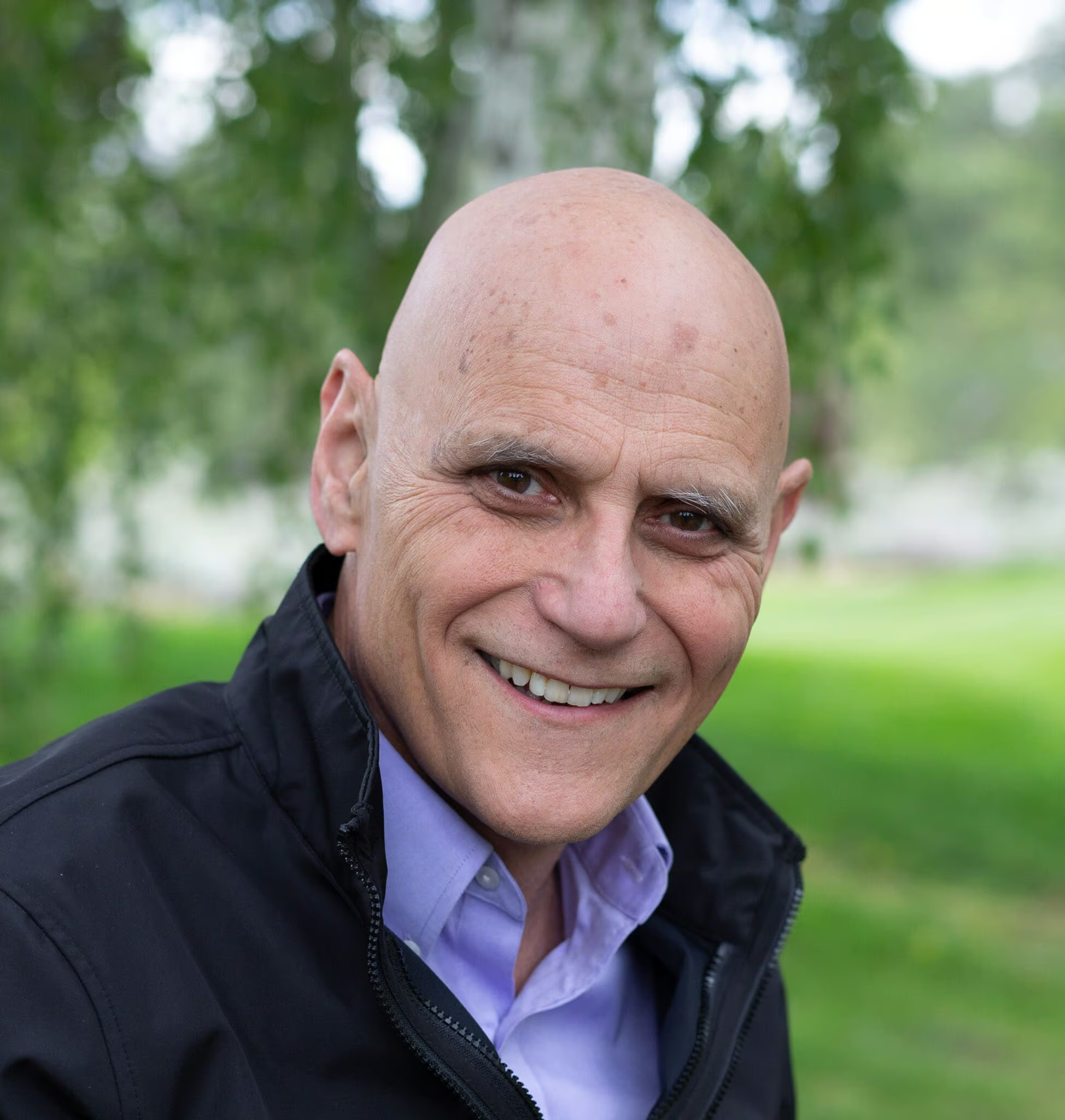
Steven C. Hayes, PhD, Among the most cited and innovative psychologists in the world, Steven Hayes is the originator of Acceptance and Commitment Therapy (ACT) and Relational Frame Theory (RFT), and co-developer of Process-Based Therapy (PBT). Dr. Hayes is best-selling author of Get Out of Your Mind and Into Your Life and Nevada Foundation Professor at the Department of Psychology at the University of Nevada. An author of 44 books and nearly 600 scientific articles, he has shown in his research how language and thought leads to human suffering and has developed ACT as a way of correcting these processes. Hayes has been president of several scientific societies and has received several national awards, such as the Lifetime Achievement Award from the Association for Behavioral and Cognitive Therapies.
His popular book was featured in Time Magazine among several other major media outlets, and for a time was the number one best-selling self-help book in the United States. Steven Hayes speaks on internationally on acceptance and mindfulness and is one of the world’s most influential and cited clinical psychologists.
Speaker Disclosures:
Financial: Steven Hayes is the Foundation Professor Emeritus of the University of Nevada. He is the President of Institute for Better health and PsychFlex, Inc. Steven Hayes receives a speaking honorarium and recording royalties from PESI, Inc. He has no relevant financial relationships with ineligible organizations.
Non-financial: Steven Hayes is a fellow of the American Association for the Advancement of Science, the American Psychological Society, the Association for Behavioral and Cognitive Therapies, the Association for Contextual Behavioral Science, and the Association for Behavioral Analysis International. He serves on the scientific advisory committee for MIND foundation. He is a series editor for several publications, for a complete list contact PESI, Inc.
Additional Info
Questions?Visit our FAQ page at www.pesi.com/faq or contact us at www.pesi.com/info
Access for Self-Study (Non-Interactive)
Access never expires for this product.
For a more detailed outline that includes times or durations of time, if needed, please contact cepesi@pesi.com.



Target Audience
- Addiction Counselors
- Counselors
- Marriage Family Therapists
- Psychologists
- Social Workers
Objectives
- Identify the key components of psychological flexibility and understand why they are crucial for mental and behavioral health from both a scientific and intuitive perspective.
- Show increased skill in recognizing these flexibility processes in clients and in themselves, turning implicit knowledge into explicit action within therapy sessions.
- Evaluate the effectiveness of an idiographic approach to therapy, appreciating that while each client is unique, there are common processes of change that can be addressed.
- Demonstrate how to leverage your existing knowledge and skills to enhance client flexibility without necessarily needing to adopt an entirely new therapeutic method.
- Explore how the therapeutic relationship can be used as a direct model for teaching psychological flexibility, fostering empowerment in clients.
- Discuss modern measurement tools and AI that will help us personalize and scale therapeutic interventions, focusing on empowerment.
- Discuss strategies for addressing contemporary societal issues through the lens of empowerment, using flexibility skills to navigate challenges like trauma or global distress, anxiety, and sadness.
- Develop a plan to integrate these empowerment processes into your practice, enhancing your ability to support clients in achieving transformative change.
Outline
The key components of psychological flexibility and understand why they are crucial for mental and behavioral health from both a scientific and intuitive perspective.
How to recognize psychological flexibility processes in clients and utilize in session
How to address each unique client based on the common processes of change
Teaching and empowering clients through psychological flexibility techniques
Modern measurement tools and AI that help personalize and scale therapeutic change
Integrating processes of change into your practice
Reviews
Satisfaction Guarantee
Your satisfaction is our goal and our guarantee. Concerns should be addressed to: PO Box 1000, Eau Claire, WI 54702-1000 or call 1-800-844-8260.
ADA Needs
We would be happy to accommodate your ADA needs; please call our Customer Service Department for more information at 1-800-844-8260.
Please wait ...