

This program is not active.
Digital Seminar
Purchase Additional Participant CE »
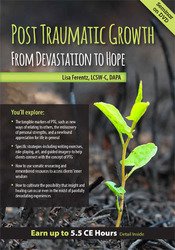
Post Traumatic Growth: From Devastation to Hope
- Average Rating:
- 202
- Faculty:
- Lisa Ferentz, LCSW-C, DAPA
- Duration:
- 5 Hours 02 Minutes
- Format:
- Audio and Video
- Copyright:
-
Mar 23, 2017
- Product Code:
- NOS052740
- Media Type:
- Digital Seminar
Description
Although it’s important for therapists to help clients process the painful and often demoralizing effects of trauma, it’s also crucial to nurture their potential for new possibilities of healing through post-traumatic growth (PTG). In fact, learning respectful ways to plant seeds of hope and resilience can make all the difference when working with trauma survivors. In this workshop, you’ll explore:
- The tangible markers of PTG, such as new ways of relating to others, the rediscovery of personal strengths, and a newfound appreciation for life in general
- Specific strategies—including writing exercises, role-playing, art, and guided imagery—to help clients connect with the concept of PTG
- How to use somatic resourcing and remembered resources to access clients’ inner wisdom
- How to cultivate the possibility that insight and healing can occur even in the midst of painfully devastating experiences
Credit
Handouts
| File type | File name | Number of pages | |
|---|---|---|---|
| Handouts (0.16 MB) | 8 Pages | Available after Purchase |
Faculty

Lisa Ferentz, LCSW-C, DAPA Related seminars and products
Lisa Ferentz, LCSW-C, DAPA, is a recognized expert in the strengths-based, de-pathologized treatment of trauma and has been in private practice for over 40 years. She has been an adjunct faculty member at several universities, and is the founder of The Ferentz Institute, now in its seventeenth year of providing continuing education to mental health professionals and graduating several thousand clinicians from her two certificate programs in advanced trauma treatment. In 2009 she was voted the “Social Worker of the Year” by the Maryland Society for Clinical Social Work. She is the author of Treating Self-Destructive Behaviors in Trauma Survivors: A Clinician’s Guide, now in its second edition, Letting Go of Self-Destructive Behaviors: A Workbook of Hope and Healing and Finding Your Ruby Slippers: Transformative Life Lessons from the Therapist’s Couch.
Speaker Disclosures:
Financial: Lisa Ferentz maintains a private practice and is the founder and president of the Ferentz Institute. She receives royalties as a published author and is a consultant for Northwest Hospital. Lisa Ferentz receives a speaking honorarium and product royalties from Psychotherapy Networker and PESI, Inc. She has no relevant financial relationships with ineligible organizations.
Non-financial: Lisa Ferentz is a member of the National Association of Social Workers and the American Psychotherapy Association.
Additional Info
Access for Self-Study (Non-Interactive) Access never expires for this product.Target Audience
Psychologists, Physicians, Addiction Counselors, Counselors, Social Workers, Marriage & Family Therapists, Nurses, and other Behavioral Health ProfessionalsOutline
- History - typical clinical approaches to trauma emphasize ameliorating symptoms and dysfunction
- Trauma also offers hope of transcendence and growth
- Positive psychology, recognizing capability for growth and planting the seeds for post traumatic growth
- Necessity and utility of expressive therapies
- Awareness of anxiety and resistance related to expressive approaches
- Trauma assessment should look for client resilience as well as dysfunction and vulnerabilities
- Trauma survivors may not recognize their own existing strengths and coping mechanisms
- Strengths begin with taking on the effort and risk involved in engaging in the therapy process
- Use of metaphor in the therapeutic process and in expressive work
- Finding beauty in struggle and pain
- Recognizing that all clients will not experience post-traumatic growth
- Validating growth without framing trauma as a positive experience
- Importance of attaching functional meaning to traumatic experiences
- Interpreting symptoms through assigned meaning
- Attached meanings with negative impact
- Subjective interpretation of events exacerbating or minimizing impact of trauma
- Impact of traumatic experiences on self-image and interpersonal behavior
- Effective use of art and expressive therapies
- Facilitating projective expression
- Identifying and validating strengths and survival techniques
- Evaluating current utility of prior strategies
- Appropriate timing of therapeutic steps
- Identifying personality factors associated with vulnerability and growth
- Planting the seeds of post-traumatic growth
- Case example
- Assessment questions, evaluation of strengths and symptoms
- Common misdiagnoses
- Function and self-acceptance of negative behaviors
- Evaluating client self-talk
- Modeling compassion and curiosity
- Journaling exercise
- Resources for positive self-talk and self-judgement
- Facilitating Resilience
- Cognitive approaches
- Utilizing positive self-statements
- Utilizing assessment instruments sensitively
- Post-traumatic Growth Inventory
- Patient Health Questionnaire – 9
- Sand Tray
- Case example – Post-traumatic growth
- Somatic Resourcing
- Exercise - Accessing internal wisdom and compassion
- Belief in new possibilities – tangible evidence of post-traumatic growth
- Accepting reasonable risks
- Attending to and creating new opportunities
- Transcending trauma
- Case example – Working with Dissociative Identity Disorder
- Therapeutic Exercises – Moving from PTSD to post-traumatic growth
- Relating to others
- Restoring and creating social relationships
- Healing disrupted perceptions of others, diminishing sense of threat
- Therapeutic Exercise – Two handed writing
- Identifying and integrating traumatized aspects of self
- Facilitating containment, control and safety for vulnerable clients
- Using parts language effectively – reducing competition and shame, managing nonverbal parts
- Spiritual Changes
- Addressing disruptions of faith stemming from abuse
- Utilizing spiritual reconciliation as resource
- Case example – restoring faith post trauma
- Newfound appreciation for life as evidence of post-traumatic growth
- Case example – finding meaning in the face of terminal illness
- Achieving perspective and freedom
- Gratitude and neurochemistry
- Therapeutic exercise – facilitating gratitude
- Forgiveness – correlation with post-traumatic growth
- Useful but not necessary
- Facilitation strategies
Objectives
- Identify and utilize markers of Post-Traumatic Growth (PTG) to increase resiliency and guide treatment planning.
- Theorize how to cultivate growth, insight, and development in the midst of traumatic experiences.
- Utilize ‘somantic resourcing’ and ‘remember resources’.
- Formulate expressive and art-based techniques to encourage PTG, including writing exercises, role-playing, art, and guided imagery.
- Integrate philosophical and conceptual elements of PTG into traditional treatment modalities.
- Practice assessment of client strengths and personality factors to enhance PTG.
Reviews
| 5 |
|
| 4 |
|
| 3 |
|
| 2 |
|
| 1 |
|
Overall: 4.8
Total Reviews: 202
Satisfaction Guarantee
Your satisfaction is our goal and our guarantee. Concerns should be addressed to: PO Box 1000, Eau Claire, WI 54702-1000 or call 1-800-844-8260.
ADA Needs
We would be happy to accommodate your ADA needs; please call our Customer Service Department for more information at 1-800-844-8260.
Please wait ...