

Digital Seminar
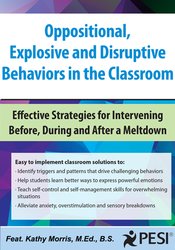
Oppositional, Explosive and Disruptive Behaviors in the Classroom: Effective Strategies for Intervening Before, During and After a Meltdown
- Average Rating:
- 1
- Faculty:
- Kathy Kaluza Morris, MEd, BS
- Duration:
- Full Day
- Format:
- Audio and Video
- Copyright:
-
Feb 26, 2020
- Product Code:
- POS055635
- Media Type:
- Digital Seminar

Description
Do you work with students who exhibit explosive behaviors that interfere with their ability to effectively and efficiently navigate their environment? They appear willful, obnoxious, over reactive, and unfeeling. They lose control of their ability to cope or regulate their behavior, which can send them spiraling into a gut wrenching meltdown.
Watch expert Kathy Morris, M.Ed., B.S., and learn proven strategies and techniques to help students with ADHD, ODD, autism, executive functioning, learning disabilities, anxiety, and depression de-escalate before a full blown meltdown ensues, developing self-control and self-management skills to prevent future meltdowns and learn appropriate/replacement behaviors. Dozens of strategies will be taught through dynamic video case examples and demonstrations. “Teach them in the way they learn” will be a mantra throughout the recording.
Walk away with these intervention strategies and more:
- Breathe card and emotions chart to develop self-control and self-management skills
- Surprise cards, change of schedule cues, and transition markers to alleviate anxiety
- Video modeling and role playing to improve social/emotional communication
- First person stories and visual cues to promote positive behavior
- Visual cues, music, and software designed to increase attention and focus
- Social stories, social scripts, and emotions charts to develop self-regulation
- SOCCSS, keychain rules, and t-charts to target challenging behaviors
Credit
Handouts
| File type | File name | Number of pages | |
|---|---|---|---|
| Manual - Oppositional, Explosive and Disruptive Behaviors in the Classroom (56.6 MB) | 90 Pages | Available after Purchase | |
| Text Document | Illinois Educators Self-study Instructions (28.5 KB) | Available after Purchase | |
| Illinois Educators Evaluation Form (1.2 MB) | Available after Purchase |
Faculty

Kathy Kaluza Morris, MEd, BS Related seminars and products
igivuWings
Kathy Morris, MEd, BS, has over 42 years of experience working with children and adolescents with severe behavioral difficulties, autism, ADHD, executive dysfunction, and cerebral palsy. She has been a speech therapist, teacher for self-contained programs, resource teacher, and first grade teacher. Kathy's business, igivuWings, has reached families, educators, counselors, speech pathologists, occupational therapists, and medical professionals throughout the world.
Kathy was a diagnostician/supervisor for all grade levels and a LIFE Skills/autism/behavior/assistive technology consultant at a Texas education service center before leaving to start her own business. A prolific speaker, Kathy has keynoted many national/international conferences. She provides technical assistance in classrooms across the US, Canada, and several international countries. Kathy is a frequent guest on a local news program promoting research-based techniques for working with children and adolescents with executive functioning deficits, ADHD, and Autism Spectrum Disorder.
Kathy was honored as Outstanding Educator for Children with Disabilities (1997) and a delegate for the President's Commission on Special Education (2002).
Speaker Disclosures:
Financial: Kathy Morris maintains a private practice. She has authored an audio product, books and a DVD product which are published by the Bureau of Education & Research. Kathy Morris is an consultant for Assistive Technology, Inc. She receives a speaking honorarium and recording royalties from PESI, Inc. All relevant financial relationships with ineligible organizations has been mitigated.
Non-financial: Kathy Morris is the mother of adult children with autism spectrum disorders.

Additional Info
Access for Self-Study (Non-Interactive)Access never expires for this product.
Objectives
- Discriminate functions of behavior during a tantrum vs. meltdown.
- Illustrate the connections and breakdowns between communication, social skills, and behaviors.
- Employ a breathe card and emotions chart to develop self-control and self-management skills.
- Design optimal classroom structure to prevent overstimulation and sensory breakdowns.
- Employ SOCCSS, keychain rules, and t-charts to prevent, intervene, or consequate targeted behaviors.
- Utilize surprise cards, change of schedule cues, and transition markers to alleviate anxiety.
Outline
Functions of a Meltdown- Tantrum vs. meltdown
- Stages of a meltdown
- Sensory issues vs. behavior issues
- Meltdown intervention video
- Attention Deficit Hyperactivity Disorder (ADHD)
- Oppositional Defiant Disorder (ODD)
- Autism Spectrum Disorder (ASD)
- Learning disabilities
- Executive functioning deficits
- Anxiety disorder
- Depression
- Easy-to-use sensory tools and apps to calm
- Overstimulation and sensory breakdowns
- Classroom structure for optimal learning
- Visual cues, music, and software designed to increase attention and focus
- High interest areas to strengthen motivation and engagement
- Visual reminders for routines and predictability
- Visual structures to promote organization
- Video modeling, t-charts, social stories, social scripts, emotions charts to develop self-control
- Tools that promote self-monitoring of behavior
- Power cards and visual checklists as powerful incentives to change behavior
- Social scripts and social stories to develop social interaction
- Video modeling and role playing to demonstrate appropriate interactions
- First person stories for positive behavior changes and affirmations
- Recognize the warning signs of a meltdown to prevent it
- Surprise cards, change of schedule cues, and transition markers to alleviate anxiety
- Visual cues to depict expected behavior
- Converting the verbal to a visual
- Strategies for instructional consequences
- Chart appropriate/inappropriate behaviors
- Activities for reviewing behaviors when calm
- Cartooning to facilitate feedback
- Strategies for providing systematic feedback
- Reinforcement for communication strategies
- Identify feelings and review behavior
- Demonstration video of child having a meltdown
- Appropriate and meaningful replacement behaviors for physical aggression
- Instructional consequences for a meltdown
Target Audience
- Educators
- School Administrators
- Educational Paraprofessionals
- School Counselors
- School Social Workers
- School Psychologists
- School Guidance Counselors
- Speech-Language Pathologists
- Speech-Language Pathology Assistants
- Occupational Therapists
- Occupational Therapy Assistants
- Counselors
- Social Workers
- Psychologists
- Marriage and Family Therapists
- Physical Therapists
- Physical Therapist Assistants
- Other Helping Professionals who Work with Children
Reviews
| 5 |
|
| 4 |
|
| 3 |
|
| 2 |
|
| 1 |
|
Overall: 5
Total Reviews: 1
Satisfaction Guarantee
Your satisfaction is our goal and our guarantee. Concerns should be addressed to: PO Box 1000, Eau Claire, WI 54702-1000 or call 1-800-844-8260.
ADA Needs
We would be happy to accommodate your ADA needs; please call our Customer Service Department for more information at 1-800-844-8260.
Please wait ...