

This program is not active.
Digital Seminar
Purchase Additional Participant CE »
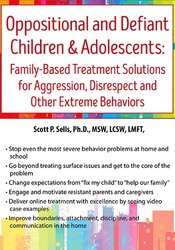
Oppositional and Defiant Children & Adolescents: Family-Based Treatment Solutions for Aggression, Disrespect and Other Extreme Behaviors
- Average Rating:
- Not yet rated
- Faculty:
- Scott Sells, PhD, MSW, LCSW, LMFT
- Duration:
- 6 Hours 31 Minutes
- Copyright:
-
Jan 22, 2021
- Product Code:
- POS057395
- Media Type:
- Digital Seminar
Description
Out of Control behavior involves the entire family – shouldn’t your treatment do the same?
The parent’s mantra of “just fix my kid” isn’t the most effective because while you can make some progress individually, relapse rates skyrocket when the child returns to the same unhealthy patterns/behaviors/ environment. Oppositional and Defiant children and adolescents are often referred to treatment because of extreme emotional or behavior problems – aggression, disrespect, skipping school, self-harm, suicide, running away – and not the underlying trauma and unhealthy family dynamics that are the real cause of the problem.
Watch Dr. Scott Sells, founder of the Family Systems Trauma (FST) Model and creator of Parenting with Love and Limits®, to learn 7 must have, evidence-based techniques for assessing and treating the oppositional and defiant child or adolescent in whole new way.
Under Dr. Sells’ expert guidance, you’ll discover how you can:
- Engage and motivate even your most resistant children, parents, and families
- Use step-by-step tools with handouts and scripts to use immediately with clients
- Identify the underlying reason for defiance and what are called “undercurrents” to quickly find the solution
- Keep your sessions strength-based and solution-oriented
- Empower parents to heal trauma, improve boundaries, and restore attachment
- Overcome the most common treatment roadblocks that frustrate you and your client
If you’re treating out of control children and their parents, you need these techniques in your clinical toolbox - purchase today!
Credit
Handouts
| File type | File name | Number of pages | |
|---|---|---|---|
| Manual - Oppositional and Defiant Children & Adolescents (30.3 MB) | 143 Pages | Available after Purchase | |
| Safety Stressors Questionnaire (88.1 KB) | 1 Pages | Available after Purchase | |
| Bonus Slides (1.8 MB) | 10 Pages | Available after Purchase | |
| Illinois Educators Self-Study Instructions (15.4 KB) | Available after Purchase | ||
| Illinois Educators Evaluation Form (1.2 MB) | Available after Purchase | ||
| Instructions for ASHA credit - Self-Study Only (64.4 KB) | Available after Purchase |
Faculty

Scott Sells, PhD, MSW, LCSW, LMFT Related seminars and products
Savannah Family Institute
Scott P. Sells, Ph.D., MSW, LCSW, LMFT, is former tenured professor of social work, Savannah State University, Savannah, GA and Associate Professor at UNLV in Las Vegas, NV. Dr. Sells is the author of three best-selling books, Treating the Tough Adolescent: A Family-Based, Step-by-Step Guide (1998), Parenting Your Out-of-Control Teenager: 7 Steps to Reestablish Authority and Reclaim Love (2001), and Treating the Traumatized Child: A Step-by-Step Family Systems Approach (Springer, 2017). He has over 20 publications in such periodicals as Psychotherapy Networker, Contemporary Corrections, Journal of Child and Adolescent Substance Abuse, Professional Issues in Criminal Justice, Family Process, and Journal of Marital and Family Therapy, plus book chapters in the Handbook of Family Therapy Research Methods (1996) and Social Worker’s Desk Reference, 2/E (2008).
Dr. Sells has extensive experience as a keynote speaker for the American Association of Marriage and Family Therapy, the National Association of Social Workers, the Southeastern Psychological Association, and others. He was invited to be one of six expert presenters at the American Association of Marriage and Family Therapy’s prestigious Summer Institutes as well as the world-renowned Cape Cod Institute. Dr. Sells is currently the founder and model developer of an evidence-based model as the FST | Family Systems Trauma Model that is being used by both juvenile justice and child welfare in over 14 states and in Europe.
Speaker Disclosure:
Financial: Scott Sells is the owner of Savannah Family Institute, Inc. He receives a speaking honorarium from PESI, Inc. He has no relevant financial relationships with ineligible organizations.
Non-financial: Scott Sells has no relevant non-financial relationship to disclose.
Additional Info
Access for Self-Study (Non-Interactive)Access never expires for this product.
Objectives
- Evaluate the connection between extreme behavior and an upside-down hierarchy and family trauma.
- Integrate a 7-question Motivational Script to motivate the toughest parents to show up and cooperate.
- Utilize therapeutic tools, scripts, and handouts to more effectively treat oppositional and defiant behaviors.
- Assess “toxic seeds” and “undercurrents”, or hidden causes of a child or adolescent’s extreme behaviors within the family to increase the effectiveness of treatment.
- Create clinical treatment plans using playbooks to address the specific needs of each client/family.
- Utilize various scaling techniques to evaluate progress in treatment and identify potential risks for relapse.
- Analyze when it is appropriate to begin active treatment as opposed to stabilization of extreme behaviors to ensure the safety of the child and family members.
Outline
Oppositional and Defiant Children and What Makes Them Tick- Long-term impact of out of control behavior and an upside-down hierarchy
- Why family trauma so often the cause but unseen and untreated
- “Teen terrorism” and how it defeats both parents and counselors
- “Rules without relationships” lead to an out of control child
- Video case example: Interactional Trauma: A single parent mom and child who are both out of control
- Motivate your toughest parents so they will show up and cooperate
- A 7-question script to start and end treatment
- Move quickly beyond the roadblock of “just fix my kid”
- The “stick and move” technique and “closing arguments” to set the terms of treatment
- How to use the Motivational Phone Call to engage the extended family
- Case example: Listen to an actual motivational phone call
- Scale from 0% (no stress) to 100% (total stress) to quickly get to the child’s problem(s)
- Four toxic seeds and undercurrents that maintain the child’s extreme behavior or symptoms
- Assess for the child’s safety stressors
- Self-harm, suicide, bullying, aggression, drug use, etc.
- Rules for when to stabilize the child’s extreme behaviors and when to start active trauma treatment
- Set goals of therapy with defiant kids that actually work
- Video case example: “Knowing where to tap” to locate the root causes of the child’s out of control behavior
- Is clear, written, and pre-determined to set up both child and family for success, not failure
- Heals the stronghold of shame, blame, performance and approval
- Locates the child’s love language
- Neutralizes the child’s “five aces” of running away, truancy, safety issues, aggression and disrespect
- Video case examples: “Extreme kids and Written Playbooks that Work”
- Why defiant kids are master button pushers and using button busters to stop it
- Why dress rehearsals to practice delivery and troubleshooting to think two steps ahead is so needed
- How to set-up and execute the best dress rehearsals and troubleshooting of your life
- Video case example: Watching a great dress rehearsal unfold and seeing immediate change in the child
- Mini-scales technique: The child and family taking credit for the changes
- Map out next steps of treatment and beyond
- Identify red flags to prevent potential relapse
- Video case example: See the mini-scales and decision tree techniques in action
- 5 key questions to ask at the end of each session to instantly get better outcomes in real time
- How real-time client feedback will improve outcomes
- How to elicit honest responses from clients and families
- Delivery vs. content: It’s not what you say but how you say it
- Video case example: “We finally feel a part of the treatment”
Target Audience
- Counselors
- Social Workers
- Psychologists
- Marriage and Family Therapists
- Speech-Language Pathologists
- Teachers
- School Guidance Counselors
- Case Managers
- Nurses
- School Administrators
- Educational Paraprofessionals
- Occupational Therapists & Occupational Therapy Assistants
- Other Helping Professionals that Work with Children
Reviews
Satisfaction Guarantee
Your satisfaction is our goal and our guarantee. Concerns should be addressed to: PO Box 1000, Eau Claire, WI 54702-1000 or call 1-800-844-8260.
ADA Needs
We would be happy to accommodate your ADA needs; please call our Customer Service Department for more information at 1-800-844-8260.
Please wait ...