

Digital Seminar
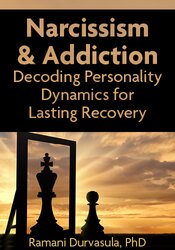
Narcissism & Addiction
Decoding Personality Dynamics for Lasting Recovery
- Average Rating:
- Not yet rated
- Faculty:
- Ramani Durvasula, PhD, LCP
- Duration:
- 1 Hour
- Copyright:
-
Aug 09, 2024
- Product Code:
- POS059982
- Media Type:
- Digital Seminar
Description
Sadly, personality is often overlooked when working with clients living with addiction, and personality assessments often do not inform treatment planning.
Narcissism and other antagonistic personality styles can turn addiction therapy into a complex puzzle. And understanding these personality dynamics is the key to preventing relapse and achieving lasting change.
Join Ramani Durvasula, PhD, New York Times best-selling author of It’s Not You: Identifying and Healing from Narcissistic People for an exploration of narcissism and its impact on addiction treatment. Dr. Durvasula offers a comprehensive overview of narcissism and Narcissistic Personality Disorder (NPD), including DSM formulations and relationship dynamics, guiding you through:
- How narcissistic traits complicate assessment, treatment, and long-term management of substance use disorders
- The parallels between narcissism and addiction, and gain insights into effective engagement strategies for this challenging population
- The intersection of narcissism, trauma, and substance use disorders, and explore practical tips for maximizing clinician efficacy as well as for families, spouses, partners, and friends
Don't let narcissism derail your addiction treatment efforts. Register now to gain valuable strategies for working with this complex population and achieving better outcomes for your clients.
Credit
Handouts
| File type | File name | Number of pages | |
|---|---|---|---|
| Manual - Narcissism & Addiction (2.5 MB) | 43 Pages | Available after Purchase | |
| Manual - Narcissism & Addiction - French (2.5 MB) | 43 Pages | Available after Purchase | |
| Manual - Narcissism & Addiction - Italian (2.5 MB) | 43 Pages | Available after Purchase | |
| Manual - Narcissism & Addiction - German (2.5 MB) | 43 Pages | Available after Purchase | |
| Manual - Narcissism & Addiction - Spanish (2.5 MB) | 43 Pages | Available after Purchase |
Faculty
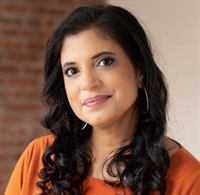
Ramani Durvasula, PhD, LCP Related seminars and products
Ramani Durvasula, PhD is a psychologist in California, the founder and CEO of LUNA Education, Training and Consulting, and professor emerita of psychology at California State University Los Angeles. She is The New York Times bestselling author of It’s Not You: Identifying and Healing from Narcissistic People. She is also the author of multiple other books including ”Don’t You Know Who I Am”: How to Stay Sane in the Era of Narcissism, Entitlement and Incivility and Should I Stay or Should I Go: Surviving a Relationship with a Narcissist. She has lectured and trained therapists around the world on best practices on working with clients experiencing narcissistic abuse and has developed a 36 hour virtual training and certification program in conjunction with PESI to train clinicians on how to use an antagonism-informed approach with clients experiencing narcissistic relationships.
Dr. Durvasula hosts a popular YouTube channel with over 2 million subscribers, maintains a program offering support and education to thousands of survivors, and is a featured expert on the digital media platform MedCircle. She also maintains an engaged online network called the Dr. Ramani Network. She has also been widely involved in the governance of the American Psychological Association, including the APA Leadership Institute for Women in Psychology and the APA Minority Fellowship Program. Dr. Durvasula received her MA and PhD degrees in clinical psychology from UCLA and completed her internship and post-doctoral training at the UCLA Department of Psychiatry. She completed her Bachelor of Science degree in psychology, with a minor in sociology in 1988 at the University of Connecticut. She resides in Los Angeles, CA.
Speaker Disclosures:
Financial: Ramani Durvasula is the founder and CEO of LUNA Education, Training, and Consulting and has an employment relationship with the University of Johannesburg. Ramani Durvasula receives royalties as a published author. She receives a speaking honorarium and recording royalties from Psychotherapy Networker and PESI, Inc. She has no relevant financial relationships with ineligible organizations.
Non-financial: Ramani Durvasula is an associate editor for Behavioral Medicine. She is a member of the American Psychological Association, the Association for Psychological Science Society for Behavioral Medicine, and the International Association of Applied Psychology.
Additional Info
Questions?Visit our FAQ page at www.pesi.com/faq or contact us at www.pesi.com/info
Access for Self-Study (Non-Interactive)
Access never expires for this product.
For a more detailed outline that includes times or durations of time, if needed, please contact cepesi@pesi.com
Objectives
- Classify conceptualizations of antagonism and narcissistic symptoms, particularly grandiose, vulnerable, and malignant factors
- Understand the relationship, including the role of dysregulation and impulsivity, between narcissism and substance use/addiction
- Manage and treat co-occurring narcissism and substance use/addiction
Outline
Why It’s So Important to Consider Narcissism When Treating Persons Living with SUDs
- Building personality into addiction treatment planning
- The inter-relationship between narcissism, antagonism, substance use, and addiction
- A relative dearth of empirical literature, especially treatment literature
Overview of Narcissism and Antagonistic Personality Styles
- DSM-5 and ICD diagnostic frameworks
- The continuum of narcissism
- Subtypes of narcissism
- The ongoing challenges in creating consensus around narcissism and antagonism
Parallel Processes in Addiction and Narcissism
- Denial
- Projection
- Rationalization
- Sense of invulnerability (I can fix anything)
- Impulsivity
- Lack of empathy
The Relationship Between Narcissism and Addiction
- Similar dynamics
- Developmental Trajectories
- Addressing motivations for entering treatment
How to Clinically Work with Clients Experiencing Narcissism and Addiction
- How does narcissism interfere with treatment?
- The Narcissistic Person as a “dry drunk”
- Goal setting with clients experiencing co-occurring addiction and narcissism.
- The challenge of not having RCTs and limited windows with these clients
How Clinicians are Impacted by these Clients
- Not addressed in training or supervision
- Manipulation and triangulation in treatment settings
- Managing expectations and process issues
- Remaining aware of positionality in this work
Target Audience
- Addiction Professionals
- Psychologists
- Social Workers
- Licensed Clinical/Mental Health Counselors
- Marriage and Family Therapists
- Case Managers
- Physicians
Reviews
Satisfaction Guarantee
Your satisfaction is our goal and our guarantee. Concerns should be addressed to: PO Box 1000, Eau Claire, WI 54702-1000 or call 1-800-844-8260.
ADA Needs
We would be happy to accommodate your ADA needs; please call our Customer Service Department for more information at 1-800-844-8260.
Please wait ...