

This program is no longer active, however there are other versions of this program in which you may be interested.
Motivational Interviewing: Evidence-Based Interventions to Improve Client Engagement and Accelerate Behavioral Change, 4/4/2025 12:00:00 AM EDT, Digital Seminar More info »
Motivational Interviewing: Evidence-Based Interventions to Improve Client Engagement and Accelerate Behavioral Change, 4/4/2025 12:00:00 AM EDT, Digital Seminar More info »
Digital Seminar
Purchase Additional Participant CE »
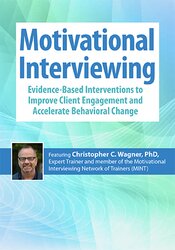
Motivational Interviewing
Evidence-Based Interventions to Improve Client Engagement and Accelerate Behavioral Change
- Average Rating:
- 8
- Faculty:
- Christopher Wagner, PhD
- Duration:
- 6 Hours 30 Minutes
- Format:
- Audio and Video
- Copyright:
-
Mar 17, 2022
- Product Code:
- POS054710
- Media Type:
- Digital Seminar - Also available: Digital Seminar
Description
Are you frustrated with having the same client sessions over and over? Perhaps you’re watching your clients struggle with addiction, anxiety, or other mental health challenges, and your attempts to empower them to make positive changes in their lives feel like going into battle. You feel like you’re working harder than your client, and you feel like they resist everything.
You can make a significant, positive impact on your clients’ lives with Motivational Interviewing.
Motivational interviewing (MI) has emerged over the past three decades as a leading approach for addressing a core clinical concern – motivation. When mastered, this evidence-based approach is highly effective in motivating positive change.
Better still, motivational interviewing can be used regardless of diagnosis and in conjunction with other treatment approaches.
Chris Wagner, Ph.D., motivational interviewing trainer and author, will teach you the skills you need to know to successfully help these clients. You’ll learn how the MI process works, how to help your clients resolve ambivalence about change, and how to effectively respond to resistance in clients. You’ll leave this seminar confident and with the strategies you need to treat your clients with depression, anxiety disorders, addictive behaviors and other clinical issues.
Escape the pattern of struggling with clients, and instead evoke your clients’ own motivation to change!
Credit
Handouts
| File type | File name | Number of pages | |
|---|---|---|---|
| Manual - Motivational Interviewing: Evidence-Based Interventions to Improve Client Engagement and Accelerate Behavioral Change (6.6 MB) | 69 Pages | Available after Purchase | |
| Manual - Motivational Interviewing: Evidence-Based Interventions to Improve Client Engagement and Accelerate Behavioral Change - French (6.6 MB) | 69 Pages | Available after Purchase | |
| Manual - Motivational Interviewing: Evidence-Based Interventions to Improve Client Engagement and Accelerate Behavioral Change - Italian (6.6 MB) | 69 Pages | Available after Purchase | |
| Manual - Motivational Interviewing: Evidence-Based Interventions to Improve Client Engagement and Accelerate Behavioral Change - German (6.6 MB) | 69 Pages | Available after Purchase | |
| Manual - Motivational Interviewing: Evidence-Based Interventions to Improve Client Engagement and Accelerate Behavioral Change - Spanish (6.6 MB) | 69 Pages | Available after Purchase |
Faculty

Christopher Wagner, PhD Related seminars and products
Virginia Commonwealth University
Christopher C. Wagner, PhD, licensed clinical psychologist, has offered hundreds of Motivational Interviewing (MI) trainings in North America, Europe, Asia, and Australia/Oceania. In addition to focusing on clinical and theoretical advances in MI, he has also developed group applications of MI and is an author of the official Guilford series book entitled Motivational Interviewing in Groups, co-written with long-time colleague Karen Ingersoll. Dr. Wagner has been practicing MI for over 20 years, and has served in leadership positions, including the board of directors, of the Motivational Interviewing Network of Trainers (MINT) – the leading international organization of trainers in motivational interviewing representing 40 countries across the globe.
Dr. Wagner’s experience spans across individuals with a variety of health, mental health, addiction, and employment challenges throughout outpatient, inpatient, residential, and corrections settings. He serves as an associate professor at Virginia Commonwealth University, where he has focused his scholarship on expanding MI theory and practice. Dr. Wagner’s trainings are highly engaging and specialized on helping participants incorporate MI skills and strategies into their current styles of practice.
Financial: Christopher Wagner has an employment relationship with Virginia Commonwealth University and receives grants from the US Department of Education. He receives royalties as a published author. Christopher Wagner receives a speaking honorarium, recording royalties and book royalties. He has no relevant financial relationships with ineligible organizations.
Non-financial: Christopher Wagner is a member of the American Counseling Association, the American Group Psychotherapy Association, and the American Psychological Association.
Alternate Options
|
Motivational Interviewing: Evidence-Based Interventions to Improve Client Engagement and Accelerate Behavioral Change
Copyright: 04/04/2025 - Product Code POS054710 |
Additional Info
Access for Self-Study (Non-Interactive)Access never expires for this product.
For a more detailed outline that includes times or durations of time, if needed, please contact cepesi@pesi.com
Questions?
Visit our FAQ page at www.pesi.com/faq or contact us at www.pesi.com/info
Objectives
- Integrate person-centered and strategic components to improve clinical outcomes using Motivational Interviewing (MI) in a positive and supportive way.
- Evaluate how the four processes and OARS skills of MI help reduce client ambivalence and empower change.
- Employ ways to elicit, recognize and respond to “change talk” to improve treatment outcomes.
- Develop clinical strategies for working effectively with clients who are resistant to change.
- Determine ways that MI can enhance the effectiveness of other existing therapeutic approaches.
- Choose how to effectively use MI to help alleviate symptoms of anxiety, depression and addictive behaviors.
Outline
Motivational Puzzles: Why People Don’t Do What’s Best for Themselves- Redefine motivation as an interactive state
- Utilize three components of change
- Desire for and fear of change in therapy
- Ambivalence across the stages of change
- How ambivalence becomes resistance
- The spirit of MI
Core MI Processes to Cultivate Change
- Engaging: The Relational Foundation
- Partnership – the core relationship
- “Dancing” vs. “wrestling”
- Avoid the “expert” role
- Foster client autonomy
- The core skills of MI
- Focusing: The Strategic Decision
- Match your agenda to the client’s goals & priorities
- Help clients develop a direction for change
- Guiding vs. directing or following
- Help clients find freedom
- How to prioritize multiple presenting issues & concerns
- Evoking: Preparation for Change
- The key ingredient of MI
- Preparatory vs. mobilizing change talk
- Elicit importance, confidence & readiness for change
- Acceptance & empathy as tools for eliciting change talk
- Help clients align values and behavior
- Aid clients in leveraging strengths
- Build momentum toward change
- Planning: Commitment to Change
- How and when to plan
- Information exchange to aid in plan development
- The “Dos” and “Don’ts” of giving advice
MI Tools for Anxiety: Inspire Clients to Engage in Previously Avoided Behaviors
- MI strategies to strengthen collaboration
- How to challenge “the way I’ve always done it” thinking
- Interventions to break familiar, anxiety-inducing patterns
- Combine MI with cognitive behavioral therapy (CBT)
MI & Depression: Boost Your Clients’ Resilience, Self-Worth & Self-Efficacy
- Overcoming ambivalence in depression
- Friends & family: Help clients learn to filter well-intentioned advice
- Accept, acknowledge, empathize
- Help clients reframe therapeutic tasks
- MI & crisis intervention
Substance Use and Addictive Behaviors: MI Strategies to Catalyze Change and Reach Recovery Goals
- What makes life worth living?
- Avoid pushback: Emphasizing choice
- Substance use
- Other addictive/compulsive behaviors
- Using MI in conjunction with the 12 steps
Research Limitations and Potential Risks
Target Audience
- Counselors
- Social Workers
- Psychologists
- Case Managers
- Addiction Counselors
- Therapists
- Marriage & Family Therapists
- Occupational Therapists
- Occupational Therapy Assistants
- Nurses
- Physicians
- Probation/Parole Officers
- Other Mental Health Professionals



Reviews
| 5 |
|
| 4 |
|
| 3 |
|
| 2 |
|
| 1 |
|
Overall: 4.9
Total Reviews: 8
Satisfaction Guarantee
Your satisfaction is our goal and our guarantee. Concerns should be addressed to: PO Box 1000, Eau Claire, WI 54702-1000 or call 1-800-844-8260.
ADA Needs
We would be happy to accommodate your ADA needs; please call our Customer Service Department for more information at 1-800-844-8260.
Please wait ...