

Digital Seminar
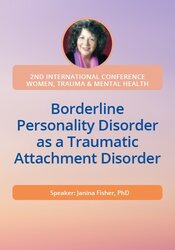
Borderline Personality Disorder as a Traumatic Attachment Disorder
- Average Rating:
- 178
- Faculty:
- Janina Fisher, PhD
- Duration:
- 1 Hour 14 Minutes
- Format:
- Audio and Video
- Copyright:
-
Nov 18, 2021
- Product Code:
- PDR058744
- Media Type:
- Digital Seminar

Description
Borderline Personality Disorder is a diagnosis that is given 50-100% more frequently to female than to male clients, not surprising given the numerous studies over the past thirty years that demonstrate a statistically significant relationship between that diagnosis and a history of childhood abuse. But despite that research evidence, BPD is rarely treated as a trauma-related condition.
We can better understand Borderline Personality as a traumatic attachment disorder. In the context of trauma, attachment failure is inevitable, leaving a lasting imprint on all future relationships. Rather than experiencing others as a haven of safety, traumatized individuals are driven by powerful wishes and fears of relationships. Their intense emotions and impulsive behavior make them vulnerable to being labeled ‘borderline’ and thus feared or dreaded by the therapists from whom they seek help.
The borderline client is not at war with the therapist. She is caught up in an internal battle: Do I dare to trust or should I not trust? Should I live or should I die? Do I love or do I hate? Understanding borderline clients as fragmented and at war with themselves transforms the therapeutic relationship and the treatment.
Credit
Handouts
| File type | File name | Number of pages | |
|---|---|---|---|
| Manual - Borderline Personality Disorder as a Traumatic Attachment Disorder (2.2 MB) | 9 Pages | Available after Purchase |
Faculty

Janina Fisher, PhD Related seminars and products
Janina Fisher, PhD, is a licensed clinical psychologist and former instructor at The Trauma Center, a research and treatment centre founded by Bessel van der Kolk. Known as an expert on the treatment of trauma, Dr Fisher has also been treating individuals, couples and families since 1980.
She is past president of the New England Society for the Treatment of Trauma and Dissociation, an EMDR International Association Credit Provider, Assistant Educational Director of the Sensorimotor Psychotherapy Institute, and a former Instructor, Harvard Medical School. Dr Fisher lectures and teaches nationally and internationally on topics related to the integration of the neurobiological research and newer trauma treatment paradigms into traditional therapeutic modalities.
She is co-author with Pat Ogden of Sensorimotor Psychotherapy: Interventions for Attachment and Trauma (2015) and author of Healing the Fragmented Selves of Trauma Survivors: Overcoming Internal Self-Alienation (2017) and the forthcoming book, Working with the Neurobiological Legacy of Trauma (in press).
Speaker Disclosures:
Financial: Dr. Janina Fisher is an international expert and consultant on Trauma and Dissociation. She is a consultant for Khiron House Clinics and the Massachusetts Department of MH Restraint and Seclusion Initiative. Dr. Fisher receives royalties as a published author. She receives a speaking honorarium, recording royalties and book royalties from Psychotherapy Networker and PESI, Inc. Dr. Fisher has no relevant financial relationships with ineligible organizations.
Non-financial: Dr. Janina Fisher is on the advisory board for the Trauma Research Foundation. She is a patron of the Bowlby Center.
Additional Info
Access for Self-Study (Non-Interactive)Access never expires for this product.
For a more detailed outline that includes times or durations of time, if needed, please contact cepesi@pesi.com
Questions?
Visit our FAQ page at www.pesi.com/faq or contact us at www.pesi.com/info
Objectives
- Determine the effects of trauma-related attachment.
- Differentiate symptoms of borderline personality disorder from signs of disorganized/traumatic attachment.
- Assess the effects of disorganized attachment on interpersonal relationships.
- Appraise the Trauma-Informed Stabilisation Treatment (TIST) model and its application to the treatment of BPD.
- Apply body-centered and mindfulness-based interventions to help clients increase affect tolerance and decrease impulsive behavior.
Outline
- The effects of trauma on attachment formation in children
- Disorganized attachment status in adulthood
- Understanding BPD as a trauma-related disorder: what the research tells us
- Disorganized attachment and dissociative ‘splitting’
- Re-interpreting BPD as ‘Traumatic Attachment Disorder: how does it change the treatment?
- Increasing client ability to be mindful rather than reactive
- The use of mindfulness-based interventions
- A “right brain to right brain” approach to healing attachment wounding
Target Audience
- Counselors
- Social Workers
- Psychologists
- Psychotherapists
- Therapists
- Art Therapists
- Marriage & Family Therapists
- Addiction Counselors
- Case Managers
- Physicians
- Other Mental Health Professionals
Reviews
| 5 |
|
| 4 |
|
| 3 |
|
| 2 |
|
| 1 |
|
Overall: 4.6
Total Reviews: 178
Satisfaction Guarantee
Your satisfaction is our goal and our guarantee. Concerns should be addressed to: PO Box 1000, Eau Claire, WI 54702-1000 or call 1-800-844-8260.
ADA Needs
We would be happy to accommodate your ADA needs; please call our Customer Service Department for more information at 1-800-844-8260.
Please wait ...