

Digital Seminar
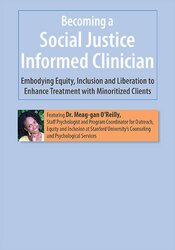
Becoming a Social Justice Informed Clinician: Embodying Equity, Inclusion and Liberation to Enhance Treatment with Minoritized Clients
- Average Rating:
- Not yet rated
- Faculty:
- Meag-gan O'Reilly, PhD
- Duration:
- 6 Hours 08 Minutes
- Format:
- Audio and Video
- Copyright:
-
Aug 10, 2021
- Product Code:
- POS058215
- Media Type:
- Digital Seminar - Also available: DVD

Description
The ingrained impacts of systemic racism affect every sector and institution of our society, pushing many to the margins by means out of their control.
And our therapeutic spaces are not untouched.
Despite our best intentions, many of us are unwittingly committing microaggressions, damaging rapport, and perpetuating inequalities. Without acknowledging power differentials and uprooting our biases we can fail marginalized clients and unknowingly participate in the oppression.
No matter your racial, ethnic or cultural background, this candid one-day training will equip you to enhance your treatment with minoritized clients and inspire you to begin using your practice as a source of systemic change!
And unlike other trainings that offer overly simplified and formulaic guidance on how to do therapy with “them,” this program will visit the uncomfortable places we need to go to become better clinicians for all of our clients.
Watch Dr. Meag-gan O’Reilly, Stanford Psychologist and CEO & Co-Founder of Inherent Value Psychology Inc., for an eye-opening exploration of how using a framework of equity, inclusion, and liberation can transform you and your clinical care.
PLUS she’ll share the key concepts, mindsets and clinical examples you need to more effectively work with the intersectionality in each client and give you actionable steps you can take to help dismantle oppressive systems and effect change at a societal level.
This is one training you can’t afford to miss.
Purchase today!
Credit
Handouts
| File type | File name | Number of pages | |
|---|---|---|---|
| Manual - Becoming a Social Justice Informed Clinician (7.6 MB) | 81 Pages | Available after Purchase | |
| Manual - Becoming a Social Justice Informed Clinician - French (7.6 MB) | 81 Pages | Available after Purchase | |
| Manual - Becoming a Social Justice Informed Clinician - Italian (7.6 MB) | 81 Pages | Available after Purchase | |
| Manual for Parts 1-2 - Becoming a Social Justice Informed Clinician - German (7.60 MB) | 81 Pages | Available after Purchase | |
| Manual for Parts 1-2 - Becoming a Social Justice Informed Clinician - Spanish (7.60 MB) | 81 Pages | Available after Purchase |
Faculty

Meag-gan O'Reilly, PhD Related seminars and products
Dr. Meag-gan O’Reilly (she/her) is a licensed psychologist, self-worth expert, DEI Consultant, and the co-founder of Inherent Value Psychology, Inc. She previously served as a staff psychologist and coordinator of Outreach Equity and Inclusion at Stanford University, where she created the first satellite clinic for black undergraduate and graduate students and co-created the Outreach and Social Justice Seminar in 2016, which trains clinicians to be culturally conscious and justice oriented. Dr. O’Reilly has taken the TEDx stage and is the creator of therapeutic healing circles for black employees in partnership with companies such as Google, The San Francisco Ballet, Virgin Pulse, and the United Negro College Fund STEM Scholars Program. Her research and writings focus on social justice, and she is the author of Systems Centered Language: A Necessity to Speaking Truth to Power During COVID-19 and Confronting Racism.
Speaker Disclosures:
Financial: Dr. Meag-gan O'Reilly has employment relationships with Inherent Value Psychology, Inc, Stanford University, and the United Negro College. She receives a speaking honorarium and recording royalties from PESI, Inc. She has no relevant financial relationships with ineligible organizations.
Non-financial: Dr. Meag-gan O'Reilly is a member of the American Psychological Association.
Additional Info
Access for Self-Study (Non-Interactive)Access never expires for this product.
For a more detailed outline that includes times or durations of time, if needed, please contact cepesi@pesi.com.
Objectives
- Analyze key points in psychology’s social justice history and understand how it shaped the practice of psychology.
- Investigate how colorblindness and the denial of racism by emphasizing that everyone is the same, or has the same life opportunities, can negatively impact clients and the therapeutic process.
- Evaluate how racial microaggressions can contribute to poor counseling outcomes in racial/ethnic minority clients.
- Analyze how mental health professionals can resist oppression through the therapeutic mechanisms they choose to employ.
- Utilize culturally responsive and racially conscious strategies to recognize the ways clients are impacted by their marginalized identities and systems of oppression.
- Assess the role of mental health professionals in dismantling oppressive systems that may impact their clients’ presenting problems.
Outline
Oppression: What All Therapists Need to Understand About Injustice- Exploitation and marginalization
- Powerlessness
- Cultural Imperialism
- Violence
- Tiers – Individual, Institutional, Cultural Internalized Oppression
- How race shapes clients’ lives
- Why therapists need to acknowledge the euro-centric culture of psychotherapy
- The truth about colorblindness in therapy
- How therapists can acknowledge power inequality in therapy as well as in society
- Therapeutic pitfalls of seeing differences in a stereotypical manner
- Tips for working with the current sociopolitical environment in therapy sessions
- How to prepare for and respond to clinical microaggressions
- Ways to bring conversations about race and class into the therapy room
- The importance of intersectionality in each client
- How clinicians can explore experiences of strengths and weaknesses of culture
- What to say – replace negative labels that can lead to ineffective treatment
- Clinical examples of culturally-affirming practices
- How power, privilege and social context impacts your clients
- How clients’ action for social change can enhance their wellbeing
- Clinical changes required for more inclusive practices
- In-session strategies to overcome struggles therapists face with inclusion
- Fundamental differences from equality
- What you can do to create access: outreach and expanding your expertise to larger communities
- Self-assessment exercise: is there equity in your practice?
- Clinical applications in therapy
- Decolonizing mental health fundamentals
- Strategies to cultivate a clinical space that fosters liberation
- Use systems centered language to combat oppressive, policies, practices, and beliefs
- How clients can regain agency in the face of oppression
Target Audience
- Social Workers
- Counselors
- Psychologists
- Psychotherapists
- Physicians
- Marriage & Family Therapists
- Addiction Counselors
- Psychiatric Nurses
- Psychiatrists
- Other Mental Health Professionals



Reviews
Satisfaction Guarantee
Your satisfaction is our goal and our guarantee. Concerns should be addressed to: PO Box 1000, Eau Claire, WI 54702-1000 or call 1-800-844-8260.
ADA Needs
We would be happy to accommodate your ADA needs; please call our Customer Service Department for more information at 1-800-844-8260.
Please wait ...